
TNPSC Books
-
 TNPSC General English Book - for Group 2 & 2A
Original price was: ₹1,000.00.₹850.00Current price is: ₹850.00.
-
TNPSC பொதுத் தமிழ் Book - for Group 2, 2A, 3, 4 & VAO
Original price was: ₹1,000.00.₹850.00Current price is: ₹850.00.
Group 1 Courses

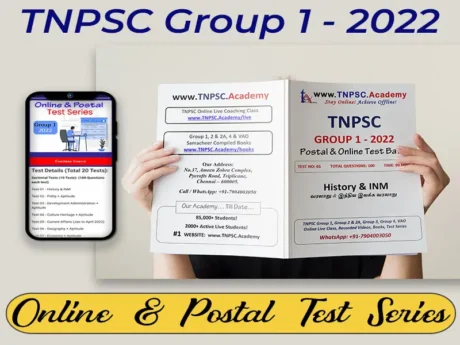
Group 1 | Postal and Online Test Series | 2022
Original price was: ₹3,200.00.₹2,800.00Current price is: ₹2,800.00. 88
TNPSC Group 1 - Test Series - 2019
Original price was: ₹3,500.00.₹2,800.00Current price is: ₹2,800.00. 542Class Tests
PRIVATE 67



Group 2 & 2A Courses
TNPSC Group 2 and 2A - Test Series - 2019
Original price was: ₹2,400.00.₹1,800.00Current price is: ₹1,800.00. 527TNPSC Group 2 and 2A - Test Series - 2019 - தமிழ்
Original price was: ₹2,400.00.₹1,800.00Current price is: ₹1,800.00. 175TNPSC Group 2 and 2A MAINS - 2022
PRIVATE 344Class Tests
PRIVATE 67




www.tnpsc.academy – TNPSC Current Affairs April 20, 2020 (20/04/2020)
Download as PDF
Topic: Public Awareness and General Administration, Latest Diary of Events
National List of Intangible Cultural Heritage (ICH) of India
Ministry of Culture has launched the National List of Intangible Cultural Heritage (ICH) of India. The National ICH List is an attempt to recognize the diversity of Indian culture embedded in its intangible heritage.
This initiative is also a part of the Vision 2024 of the Ministry of Culture.
Elements in the list:
As of now the list has more than 100 elements. It also includes the 13 elements of India that have already been inscribed on the UNESCO Representative List of the Intangible Cultural Heritage of Humanity.
Overview of the National ICH List:
Following UNESCO’s 2003 Convention for Safeguarding of Intangible Cultural Heritage, this list has been classified into five broad domains in which intangible cultural heritage is manifested:
Oral traditions and expressions, including language as a vehicle of the intangible cultural heritage;
Performing arts;
Social practices, rituals and festive events;
Knowledge and practices concerning nature and the universe;
Traditional craftsmanship.
From India the Intangible Cultural Heritages added into this list include:
Tradition of Vedic chanting
Ramlila, the traditional performance of the Ramayana
Kutiyattam, Sanskrit theatre
Ramman, religious festival and ritual theatre of the Garhwal Himalayas.
Mudiyettu, ritual theatre and dance drama of Kerala
Kalbelia folk songs and dances of Rajasthan
Chhau dance
Buddhist chanting of Ladakh: recitation of sacred Buddhist texts in the trans-Himalayan Ladakh region, Jammu and Kashmir.
Sankirtana, ritual singing, drumming and dancing of Manipur
Traditional brass and copper craft of utensil making among the Thatheras of Jandiala Guru, Punjab
Yoga
Nawrouz
Kumbh Mela
_
Topic: Latest inventions on science and health
Types of human coronaviruses
What are coronaviruses?
Coronaviruses are a large family of single-stranded RNA viruses that cause diseases in animals and humans.
Broadly, coronaviruses (CoV) are the largest group of viruses that belong to the Nidovirales order, which includes Coronaviridae among three others.
Coronavirinae are one of the two subfamilies of Coronaviridea, with the other being Torovirinae.
Coronavirinae can be further subdivided into alpha, beta, gamma and delta coronaviruses.
These viruses are named so because of spikes found on their surface that give them the appearance of a crown when looked through an electron microscope.
The first coronavirus was isolated in 1937 and it was the infectious bronchitis virus (IBV) that caused respiratory disease in chickens.
Coronaviruses which affect humans:
While there are hundreds of coronaviruses that cause diseases in animals such as pigs, camels, bats and cats, till date seven different types of coronaviruses have been identified that infect humans.
In the last two decades, more aggressive coronaviruses have emerged that are capable of causing serious illness and even death in humans. These include SARS-CoV, MERS and now SARS-CoV-2.
In 1965, scientists DJ Tyrrell and ML Bynoe were the first ones to identify a human coronavirus, which they isolated from the nasal washing of a male child who had symptoms of common cold. They termed the strain B814 and later in 1968 the term “coronavirus” was accepted.
Seven types that infect humans: Includes Two alpha coronaviruses (229E and NL63) and four beta coronaviruses (OC43, HKU1, MERS and SARS-CoV).
The sources:
Coronaviruses from all four categories can be found in mammals. But, bat coronaviruses are the likely gene source of alpha and beta coronaviruses, while avian coronaviruses are the probable gene sources of gamma and delta coronaviruses.
When the human coronaviruses were first identified?
229E: Discovered in 1967.
NL63 and HKU1: First identified in the Netherlands in 2004.
SARS-CoV: 2003 in China.
MERS: 2012 in Saudi Arabia (transmitted by dromedary camels).
SARS-CoV-2: 2019 in Wuhan (source not yet known, possibly bats).
_
Topic: Latest Diary of Events
TriboE – (masks and electricity)
A team of researchers at the Centre for Nano and Soft Matter Sciences (CeNS), Bangalore, an autonomous institute of the Department of Science and Technology (DST), have come up with a recipe for making face masks, termed as TriboE Mask, that can hold electric charges to restrict the entry of infections but interestingly, without any external power.
How they operate or work?
It relies on electrostatics. When two non-conducting layers are rubbed against each other, the layers develop positive and negative charges instantly and continue to hold the charges for some time. This electric field, quite strong at proximity, is used to deactivate or possibly even kill the germs.
Key features of these masks:
The mask is three-layered –a layer of nylon cloth sandwiched between polypropylene layers, the latter sourced from commonly used non woven grocery bags.
In place of nylon, silk fabric from an old saree or shawl may also be cut and used. When layers are rubbed against each other, the outer layers develop negative charges, while nylon will hold the positive charges.
This will act as double electric wall protection against the infectious entities crossing.
As the mask is made out of commonly available fabrics, it can be washed just like any other cloth and can be reused.
What is triboelectric effects?
Also known as triboelectric charging, it is a type of contact electrification on which certain materials become electrically charged after they are separated from a different material with which they were in contact.
Rubbing the two materials each with the other increases the contact between their surfaces, and hence the triboelectric effect.
Examples:
A very familiar example could be the rubbing of a plastic pen on a sleeve of almost any typical material like cotton, wool, polyester, or blended fabric used in modern clothing.
Such an electrified pen would readily attract and pick up pieces of paper less than a square centimeter when the pen approaches. Also, such a pen will repel a similarly electrified pen.
_
Topic: Geographical landmarks, Latest inventions on Science and Health
Lithium rich red giants
Researchers at the Indian Institute of Astrophysics (IIA), an autonomous institute under the Department of Science &Technology, Govt. of India, have discovered hundreds of Li-rich giant stars.
They have also associated such Li enhancement with central He-burning stars, also known as red clump giants, thereby opening up new vistas in the evolution of the red giant stars.
Implications:
This discovery indicates that Li is being produced in the stars and accounts for its abundance in the interstellar medium. Identifying sources of Li enrichment in our Galaxy has been a great interest to researchers to validate Big Bang Nucleosynthesis as well as a stellar mixing process.
Background:
Lithium (Li), is one of the three primordial elements, apart from Hydrogen and Helium (He), produced in the big bang nucleosynthesis (BBN).
Li in stars:
Stars are proposed as likely Li source in the Galaxy. In general, stars are considered as Li sinks. This means that the original Li, with which stars are born, only gets depleted over stars’ life-time as Li burns at relatively very low temperatures of about 2.5X10⁶ K – a range which is easily encountered in stars.
_
Topic: Science and Technology, International Events
Remdesivir
It is a drug with antiviral properties that was manufactured by US-based biotechnology company in 2014, to treat Ebola cases. It was also tried in patients of MERS and SARS, both caused by members of the coronavirus family, but experts said it did now show promising results back then. It is now being studied as a COVID-19 treatment.
_
Topic: Geographical Landmarks, Latest Diary of events
What are Blazars?
Blazars are among the brightest objects in the universe thanks to emissions powered by supersized black holes.
The most distant of the newly discovered blazars started to emit their light when the universe was just 1.4 billion years old. Previously, the most distant blazars detected by Fermi emitted their light when the universe was about 2.1 billion years old.
Blazars are similar to all active galaxies, acquiring energy from matter falling toward a central supermassive black hole. A small part of this infalling material becomes redirected into a pair of particle jets, which blast outward in opposite directions at nearly the speed of light.
_
Topic: Profile of States, General Administration
Goa is now COVID free
Goa has become the first zero COVID-19 State in the country with the last seven positive cases also turning negative. This makes Goa the first green State in the country with no case of coronavirus being reported since April 3.
_
Topic: Latest Diary of Events, Profile of States
Geo Tag Community Kitchens – UP
Uttar Pradesh became the first state to geotag community kitchens. Around 7,368 community kitchens located in 75 districts were geo tagged.
Key facts:
The State Government of Uttar Pradesh joined hands with Google to geo tag community kitchens in the state. The kitchens produce 12 lakh food packets per day. The State Government mobilized state resources on massive scale to establish the kitchens. This was done through religious organizations and non-governmental organizations.
_
Topic: Environment and Ecosystems, Latest Diary of Events
Leather back Sea Turtles build largest nests in 20 years in deserted beaches
The largest number of nests of the rare Leather back sea turtles were found in Thailand. This was mainly because, the beaches in Thailand were deserted due to COVID-19 lock down.
Key facts:
Around 11 turtle nests were found and this was the highest in 20 years. The Leather back Turtles are the world’s giant sea turtles. They are considered vulnerable under International Union for Conservation of Nature (IUCN) red list of threatened species. In Thailand, they are considered endangered. The turtles lay their eggs in quiet and dark areas.