
TNPSC Books
-
 TNPSC பொதுத் தமிழ் Book - for Group 2, 2A, 3, 4 & VAO
Original price was: ₹1,000.00.₹850.00Current price is: ₹850.00.
-
TNPSC General English Book - for Group 2 & 2A
Original price was: ₹1,000.00.₹850.00Current price is: ₹850.00.
Group 1 Courses

Class Tests
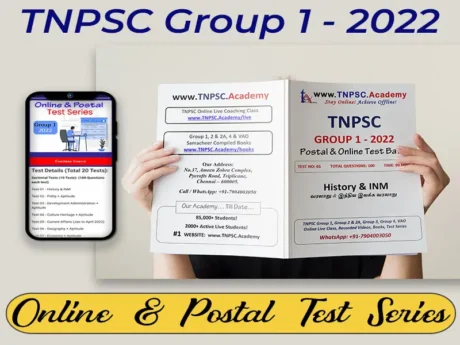
PRIVATE 67Group 1 | Postal and Online Test Series | 2022
Original price was: ₹3,200.00.₹2,800.00Current price is: ₹2,800.00. 88
TNPSC Group 1 - Test Series - 2019
Original price was: ₹3,500.00.₹2,800.00Current price is: ₹2,800.00. 542





Group 2 & 2A Courses
TNPSC Group 2 and 2A - Test Series - 2019 - தமிழ்
Original price was: ₹2,400.00.₹1,800.00Current price is: ₹1,800.00. 175TNPSC Group 2 and 2A MAINS - 2022
PRIVATE 344Class Tests
PRIVATE 67TNPSC Group 2 and 2A - Test Series - 2019
Original price was: ₹2,400.00.₹1,800.00Current price is: ₹1,800.00. 527





www.tnpsc.academy – TNPSC Current Affairs August 14, 2020 (14/08/2020)
Download as PDF (English)
Topic: Profile of States
Seed Bombs: Solution to Man-Animal Conflict
Odisha’s Athagarh Forest Division has started casting seed balls (or bombs) inside different reserve forest areas to enrich food stock for wild elephants. This has been done to prevent man-elephant conflict.
On the eve of World Elephant Day 2020, the Ministry for Environment, Forest and Climate Change has launched a portal on Human Elephant Conflict ‘Surakhsya’.
Further, the Government has taken initiative for fodder and water augmentation in forest areas so that animals get food and water in forest areas and not come outside. LiDAR technology is being used for the same.
Seed Bomb:
A seed bomb is a little ball generally made up of a combination of compost, clay and seeds.
The compost and clay act as a carrier for the seeds so they can be launched over walls or fences and into inaccessible areas such as wasteland or railways.
The compost offers nutrients for the seeds to germinate and grow strong during their infancy and the clay binds the seed bomb, making it hard enough not to break when it hits the ground. It is used in re-vegetation and reforestation of the fragile ecosystems.
The plantation technique wherein seed balls are sprayed using aerial devices, including planes, helicopters or drones, is known as aerial seeding.
_
Topic: Latest Diary of Events
OPV Sarthak
Recently, an Offshore Patrol Vessel (OPV) for the Indian Coast Guard (ICG) was launched and named as Indian Coast Guard Ship ‘Sarthak’. OPV Sarthak is the 4th in the series of the indigenous project for 05 OPVs.
OPVs are long-range surface ships capable of coastal and offshore patrolling, policing maritime zones, control and surveillance, anti-smuggling and anti-piracy operations with limited wartime roles.
_
Topic: Political System in India
Arunachal groups push for 6th Schedule status
The revival of the demand for two autonomous councils has made political parties and community-based groups call for bringing the entire Arunachal Pradesh under the ambit of the Sixth Schedule or Article 371 (A) of the Constitution.
What’s the demand?
Currently, Arunachal Pradesh is under the Fifth Schedule that “does not provide special rights for the indigenous communities” unlike the Sixth Schedule.
Many political parties have been demanding the inclusion of Arunachal Pradesh in the 6th Schedule for making the Arunachalees owner of all natural resources instead of being protectors only.
Inclusion of the state under the Sixth Schedule would enable the state to own the legitimate ownership rights over its own natural resources and make it self sufficient without having to depend too much on central grants.
What is 6th Schedule?
The Sixth Schedule currently includes 10 autonomous district councils in four northeastern States — Assam, Meghalaya, Mizoram and Tripura.
Passed by the Constituent Assembly in 1949, it seeks to safeguard the rights of tribal population through the formation of Autonomous District Councils (ADC).
This special provision is provided under Article 244(2) and Article 275(1) of the Constitution.
Key facts:
The governor is empowered to organise and re-organise the autonomous districts.
If there are different tribes in an autonomous district, the governor can divide the district into several autonomous regions. Each autonomous region also has a separate regional council.
Powers of councils:
The district and regional councils administer the areas under their jurisdiction.
They can make laws on certain specified matters like land, forests, canal water, shifting cultivation, village administration, inheritance of property, marriage and divorce, social customs and so on. But all such laws require the assent of the governor.
Village councils:
The district and regional councils within their territorial jurisdictions can constitute village councils or courts for trial of suits and cases between the tribes. They hear appeals from them. The jurisdiction of high court over these suits and cases is specified by the governor.
Powers and functions:
The district council can establish, construct or manage primary schools, dispensaries, markets, ferries, fisheries, roads and so on in the district. It can also make regulations for the control of money lending and trading by non-tribals.
But, such regulations require the assent of the governor. The district and regional councils are empowered to assess and collect land revenue and to impose certain specified taxes.
Exceptions: The acts of Parliament or the state legislature do not apply to autonomous districts and autonomous regions or apply with specified modifications and exceptions.
The governor can appoint a commission to examine and report on any matter relating to the administration of the autonomous districts or regions. He may dissolve a district or regional council on the recommendation of the commission.
_
Topic: Latest Diary of Events
India and Maldives
India announced a slew of new connectivity measures for the Maldives, including air, sea, intra-island and telecommunications in an effort to help the Indian Ocean Islands deal with the economic impact of the COVID-19 pandemic.
Initiatives announced:
Air connectivity “bubble” for travel.
A direct ferry service.
A submarine cable for telecom connectivity.
Assistance for the Greater Male Connectivity project (GMCP) to connect Male to three neighbouring islands- Villingili, Thilafushi and Gulhifahu islands.
Background:
India will support the implementation of the GMCP in Maldives, through a financial package consisting of a grant of USD 100 million and a new Line of Credit (LoC) of USD 400 million.
The GMCP would be the “largest civilian infrastructure project in Maldives”.
What is Line of Credit (LOC)?
The Line of Credit is not a grant but a ‘soft loan’ provided on concessional interest rates to developing countries, which has to be repaid by the borrowing government.
The LOCs also helps to promote exports of Indian goods and services, as 75% of the value of the contract must be sourced from India.