TNPSC Books
-
 TNPSC General English Book - for Group 2 & 2A
Original price was: ₹1,000.00.₹850.00Current price is: ₹850.00.
-
 TNPSC பொதுத் தமிழ் Book - for Group 2, 2A, 3, 4 & VAO
Original price was: ₹1,000.00.₹850.00Current price is: ₹850.00.
Group 1 Courses

Group 1 | Postal and Online Test Series | 2022
Original price was: ₹3,200.00.₹2,800.00Current price is: ₹2,800.00. 88
Class Tests
PRIVATE 67
TNPSC Group 1 - Test Series - 2019
Original price was: ₹3,500.00.₹2,800.00Current price is: ₹2,800.00. 542


Group 2 & 2A Courses

TNPSC Group 2 and 2A MAINS - 2022
PRIVATE 344Class Tests
PRIVATE 67
TNPSC Group 2 and 2A - Test Series - 2019
Original price was: ₹2,400.00.₹1,800.00Current price is: ₹1,800.00. 527
TNPSC Group 2 and 2A - Test Series - 2019 - தமிழ்
Original price was: ₹2,400.00.₹1,800.00Current price is: ₹1,800.00. 175




TNPSC – THEORY OF SETS & VENN DIAGRAMS
Theory of Sets:
Introduction
A Set is a unordered collection of objects, known as elements or members of the set. An element ‘a’ belong to a set A can be written as ‘a ∈ A’, ‘a∉A’ denotes that a is not an element of the set A.
Representation of a Set:
A set can be represented by various methods. 3 common methods used for representing set:
(i) Statement form
(ii) Roaster form or tabular form method
(iii) Set Builder method
(i) Statement form:-
In this representation, well defined description of the elements of the set is given. Below are some examples of same.
(ii) Roaster form or tabular form method:-
In this representation, elements are listed within the pair of brackets {} and are separated by commas. Below are two examples.
(iii) Set Builder method:-
In set builder set is describe by a property that its member must satisfy.
Equal sets
Two sets are said to be equal if both have same elements. For example A = {1, 3, 9, 7} and B = {3, 1, 7, 9} are equal sets.
Note: Order of elements of a set doesn’t matter.
Subset
A set A is said to be subset of another set B if and only if every element of set A is also a part of other set B. Denoted by ‘⊆‘.
‘A ⊆ B‘ denotes A is a subset of B.
To prove A is subset of B, we need to simply show that if x belongs to A then x also belongs to B.
To prove A is not a subset of B, we need find out one element which is part of set A but not belong to set B.
Size of a Set:
Size of a set can be finite or infinite.
For example:
Finite set: Set of natural numbers less than 100.
Infinite set: Set of real numbers.
Size of the set S is known as Cardinality number, denoted as |S|.
Example: Let A be a set of odd positive integers less than 10.
Solution : A = {1,3,5,7,9}, Cardinality of the set is 5, i.e.,|A| = 5.
Note: Cardinality of null set is 0.
Power Sets:
Power set is the set all possible subset of the set S. Denoted by P(S).
Example : What is the power set of {0,1,2}?
Solution: All possible subsets
{∅}, {0}, {1}, {2}, {0,1}, {0,2}, {1,2}, {0,1,2}.
Note : Empty set and set itself is also member of this set of subsets.
Cardinality of power set:
Cardinality of power set is 2^n, where n is number of element in a set.
Cartesian Products:
Let A and B be two sets. Cartesian product of A and B is denoted by A × B, is the set of all ordered pairs (a,b), where a belong to A and B belong to B.
A × B = {(a, b) | a ∈ A ∧ b ∈ B}.
Example: What is Cartesian product of A = {1,2} and B = {p,q,r}.
Solution: A × B ={(1,p), (1,q), (1,r), (2,p), (2,q), (2,r) };
Cardinality of A × B is N*M, where N is the Cardinality of A and M is the cardinality of B.
Note: A × B is not same as B × A.
VENN DIAGRAMS:-
Venn diagrams are an efficient way of representing and analyzing sets and performing set operations. As such, the usage of Venn diagrams is just the elaboration of a solving technique. Problems that are solved using Venn diagrams are essentially problems based on sets and set operations.
Thus, before we move on to understanding Venn diagrams, we first need to understand the concept of a set.
Set Operations:-
Union:
Union of the sets A and B, denoted by A ∪ B, is the set of distinct element belongs to set A or set B, or both.
Example: Find the union of A = {2, 3, 4} and B = {3, 4, 5};
Solution: A ∪ B = {2, 3, 4, 5}.
Intersection:
Intersection of the sets A and B, denoted by A ∩ B, is the set of elements belongs to both A and B i.e. set of common element in A and B.
Example: Consider the previous sets A and B. Find out A ∩ B.
Solution: A ∩ B = {3, 4}.
Disjoint:
Two sets are said to be disjoint if their their intersection is the empty set .i.e sets have no common elements.
For Example
Let A = {1, 3, 5, 7, 9} and B = { 2, 4 ,6 , 8} .
A and B are disjoint set both of them have no common elements.
Set Difference:
Difference between sets is denoted by ‘A – B’ , is the set containing elements of set A but not in B. i.e all elements of A except the element of B.
Complement:
Complement of a set A, denoted by A^\complement, is the set of all the element except A. Complement of the set A is U – A.
Example: Let A = {0, 2, 4, 6, 8} , B = {0, 1, 2, 3, 4} and C = {0, 3, 6, 9}. What are A ∪ B ∪ C and A ∩ B ∩ C ?
Solution: Set A ∪ B ∪ C contains elements which are present in at least one of A, B and C.
A ∪ B ∪ C = {0, 1, 2, 3, 4, 6, 8, 9}.
Set A ∩ B ∩ C contains element which are present in all the sets A, B and C .i.e { 0 }.
A’∩ B: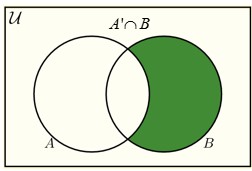
A∪B’ :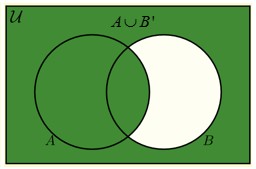
A’∪ B :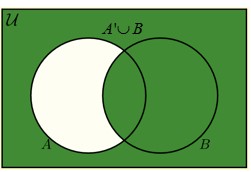
A∪ B’ = (A∩B)’ :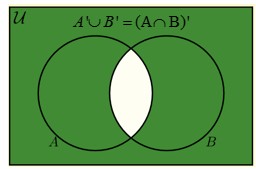
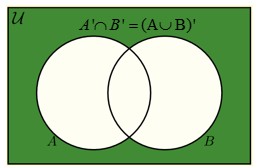
A’ ∩ B’ = (A∪ B)’ :